For years, marketers treated content discovery like a simple funnel problem: publish a blog, rank on Google, wait for traffic. That model is broken.
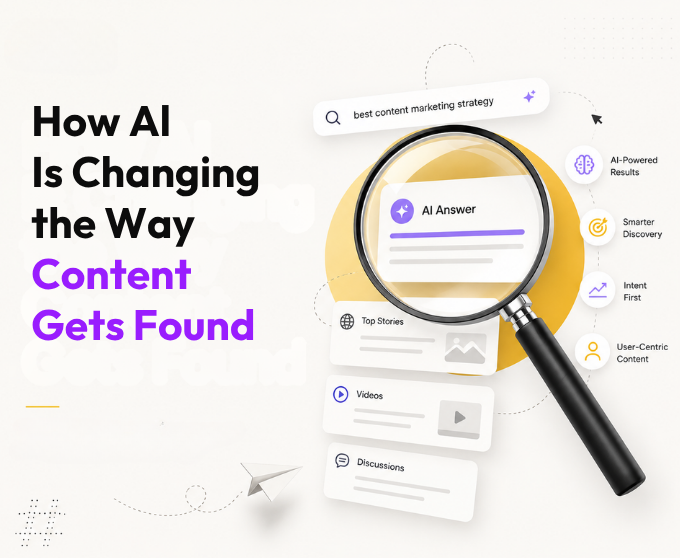
AI has changed the rules of discovery. People are no longer only finding content through search results. They are finding it through AI summaries, recommendation engines, social feeds, voice assistants, chat interfaces, and increasingly, through systems that decide what is “most useful” before a human even clicks.
That is a huge shift for B2C and D2C brands. It means discoverability is no longer just about publishing more. It is about making content legible to machines, useful to people, and credible enough to be surfaced when there is no blue link to rescue weak thinking.
If your brand still treats content as a volume game, you are already behind.
AI has moved content discovery from ranking to recommendation
Traditional SEO was built around keywords, backlinks, metadata, and technical structure. Those things still matter. But AI has introduced a second layer of judgment: context.
Search engines and AI tools now try to understand not just what a page says, but whether it is worth surfacing for a specific intent, question, or scenario. That means content is being evaluated less like a keyword match and more like an answer.
This is where many brands get it wrong. They write content for search engines, then wonder why it does not travel across AI-generated results, summaries, or assistant-led discovery. The issue is not that the content is invisible. The issue is that it is not structured to be selected.
For brands investing in SEO services, this is the wake-up call. Search visibility now depends on clarity, depth, specificity, and usefulness. In other words, content must earn attention before it can earn clicks.
The new competition is not just other brands, it is machine interpretation
AI systems are becoming the first reader of your content. They scan, summarise, compare, and extract. If your article is vague, overloaded with fluff, or buried under marketing language, it loses.
That changes the brief for every digital marketing agency and every in-house content team. The job is no longer to “create good content” in the abstract. The job is to create content that can be understood, quoted, summarised, and trusted by machines and humans alike.
In practice, that means content must do four things well:
- Answer a real question quickly.
- Show evidence, not just opinion.
- Use clear structure that is easy to parse.
- Build authority through consistency, not one-off performance.
A lot of brands still obsess over clever headlines. Clever is nice. Clear is better. AI favours content that says what it means.
Why B2C and D2C brands need to think differently
B2C and D2C brands live or die on discovery. If customers do not find you at the right moment, they do not buy from you. That is why the shift to AI-led discovery matters so much.
The discovery journey is now fragmented. A customer might first hear about a product on social media marketing channels, then ask an AI tool for comparisons, then search Google for reviews, then check the brand website, then revisit through retargeting. Content has to support all of that.
This is where many brands still think too narrowly. They treat the blog as the centre of gravity, when in reality discovery now happens across an ecosystem.
A strong content system should support:
- Search intent
- Social proof
- Product education.
- Comparison queries.
- Brand trust.
- Conversion readiness.
That is not just a content marketing agency problem. It is a brand architecture problem. If your content does not help people move from curiosity to confidence, AI will not save it.
AI rewards content that sounds like it was written for a person with a task
One of the biggest mistakes brands make is writing content that sounds polished but says very little. AI systems are getting better at detecting utility. So are users.
The most discoverable content tends to do the following:
It uses specific language
Generic phrases such as “boost growth” or “unlock potential” do nothing for discoverability. Specificity creates retrieval. If you sell skincare, say skincare. If you sell a subscription box, say subscription box. If you are answering a problem, name the problem.
It mirrors real search behaviour
People do not ask AI tools in polished brand language. They ask messy, practical questions. Your content should reflect that messiness. Build articles around the questions customers actually ask, not the categories your internal team prefers.
It explains the why, not just the what
AI can summarise facts. It struggles more with genuine perspective. That is your opportunity. The strongest content offers interpretation, trade-offs, and judgment. That is what makes it worth surfacing.
What AI-era content strategy should look like
If you want content to be found in an AI-shaped discovery landscape, stop thinking in isolated posts. Start thinking in content systems.
A better structure looks like this:
- One core topic page that defines the subject clearly.
- Supporting articles that answer related questions in depth.
- Product or service pages that tie the subject back to action.
- Comparison queries.
- Social content that extends the idea in shorter, more shareable formats.
- Internal linking that shows how all of it fits together.
This is especially important for brands working with a branding agency or a performance-led team. Brand, search, and social can no longer operate in silos. AI discovers the consistency between them.
If your website says one thing, your social says another, and your blog says something slightly different again, discovery becomes messy. Machines do not reward confusion. Neither do customers.
The practical shift brands need to make now
This is where strategy gets real. If you are serious about future-proofing discovery, your content team needs to work differently.
Start here:
- 1. Audit your top content for answer quality.
Ask whether each page solves a real problem or just fills space. - 2. Rewrite for clarity, not decoration.
Cut the jargon. Tighten the logic. Make the main point impossible to miss. - 3. Build around topics, not just keywords.
One keyword is not a strategy. A topic cluster is. - 4. Strengthen proof.
Use examples, data, process, and perspective. AI looks for signs of authority. - 5. Optimise for reuse.
A strong article should feed search, social media marketing, email, and sales enablement. - 6. Measure more than traffic.
Track saves, shares, branded search, assisted conversions, and AI-driven visibility where possible.
That last point matters. If you only measure clicks, you will miss the new discovery layer entirely.
The brands that win will not be the loudest
AI is not killing content discovery. It is forcing content to grow up.
The brands that will win are not the ones publishing the most. They are the ones publishing the clearest, most useful, most trustworthy material. They understand that discoverability is now a mix of SEO services, content quality, brand authority, and distribution discipline.
This is good news, actually. It rewards strategy over spam. It rewards expertise over volume. It rewards content that respects the reader enough to be specific.
For B2C and D2C brands, that is the real opportunity. Not just to get found, but to be chosen.
And in an AI-shaped discovery world, being chosen is the only metric that really matters.
Want your brand to be found by the right audience, not just the algorithm? Let’s
build a content strategy that works across search, AI-driven discovery, and social.
Contact Creative Nerds at +91 91670 08137.