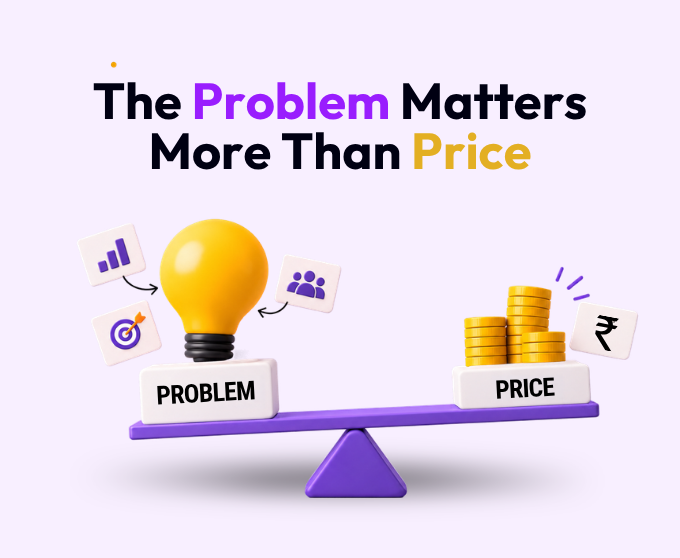
Most business owners assume their biggest threat is the competitor charging less, but the real threat is usually confusion. When a customer cannot explain, in one sentence, the exact problem your brand solves, no price you set will ever feel fair to them, high or low. That's the uncomfortable truth many Indian brands are running into right now, where a company can run polished social media marketing every day and still lose customers to a weaker, cheaper rival, because its brand positioning never made clear what problem it fixes.
Why "We're Cheaper" Stops Working So Fast
Cutting your price feels like a safe move because the results are easy to measure. You drop the rate, watch a short bump in sales, and assume it worked, until the bump fades and your best customers start waiting for the next discount instead of trusting what you charge. Harvard Business Review examined this dynamic in a widely cited study and found that price wars rarely produce winners, only shrinking margins for everyone involved. Airlines learned this the hard way in 1992: fares dropped, air travel hit record volumes, and the industry's losses that year were, by some estimates, larger than its combined profits since the industry began, a clear sign that low price alone has never made people love a brand.
The moment a business leads with "we're cheaper," it has quietly admitted that its product has no other story worth paying for, and that's rarely a pricing problem so much as a brand positioning failure dressed up as a discount.
The Social Media Marketing Trap Nobody Talks About
When sales slow down, most founders assume the fix is more content, more boosting, and more ad spend, so they pour money into social media marketing without fixing the actual issue, which is that nobody understands the problem their brand solves.
The numbers back this up in a way that's easy to miss. Keen Decision Systems' 2026 Marketing Investment Framework & Decision Guide, based on more than $42 billion in real marketing spend across 400-plus brands, found that the share of ad budgets going to social media marketing actually slipped from 18 percent to 17 percent in 2025, even as brands pushed more of what remained toward top-of-funnel, brand-building placements, which looks less like brands caring less about the channel and more like them finally being forced to get deliberate about why they're showing up on it at all.
If your social media marketing is loud but your positioning underneath it is fuzzy, you're shouting a sentence that's missing its verb, and people scroll past. No amount of boost budget fixes an unclear answer to "why should I choose you."
What Brand Positioning Actually Means, In Plain Words
Forget whatever definition your old marketing professor gave you; positioning is really just the specific problem your brand is known for solving, living inside the head of the person who has that problem, nothing more complicated.
Nike, for instance, was never really positioned around shoes so much as around the ongoing fight between doing something and doubting yourself, and it's worth noticing that price doesn't come up anywhere in that story.
This is part of why the numbers tend to surprise founders. PwC's own global research found that customers worldwide will pay up to 16 percent more for a brand that gets their experience right. Separately, McKinsey's own pricing research on S&P 1500 companies found that a one percent price increase, when volumes hold steady, can lift operating profit by roughly 8 percent on average. Volumes holding steady is the operative condition there, and that tends to happen when customers already understand why a price is what it is, which is a positioning job long before it's a finance one.
How to Compete Without Lowering Price
The actual playbook has very little in common with a motivational poster. Start by naming the problem before you name the product, so your homepage, reels, and pitch deck open with the exact headache your customer has, in their own words. From there, your social media marketing should be built to show the before and after of that headache rather than to showcase the logo. Sprout Social's own 2025 research found that authenticity and relatability are the two traits consumers value most in a brand, and that original content, not jumping on trends, is what roughly half of them say makes a brand stand out on social. In practice, a post rarely earns a save because the logo looked good; it earns one because it named a real problem and made the fix look obvious.
It also helps to charge for the outcome rather than the effort: a client isn't paying for hours worked so much as for a problem that disappears, and the price should reflect that, not a timesheet. Alongside that, learn to say no to the customer who only asks for your lowest rate, since that customer was rarely going to stay loyal, and chasing them erodes positioning, project by project. Finally, let one clear brand positioning statement run through every channel, from your website and proposals to your social media marketing and sales calls, because repeating the same problem solved the same confident way builds trust far more than another discount ever could.
This, in practice, is how to compete without lowering price, and while it's a slower path than a discount code, it's also the only one that compounds instead of quietly expiring.
Conclusion
Look at any category leader you admire. They rarely lead with price. They lead with the problem, because pricing becomes a secondary conversation once a customer believes the brand understands their needs better than anyone else in the room.
More ad spend, bigger influencer budgets, and more content cannot compensate for weak positioning.
That is the gap Creative Nerds works on.
We do not chase every trend or fill your feed with generic captions. We build positioning that gives your brand a clear reason to be chosen, then turn that positioning into social media, content, and creative that gives people something worth stopping for.
Because if every sales conversation keeps coming back to rates instead of results, the problem may not be your pricing.
It may be that your brand has not made its value clear enough.