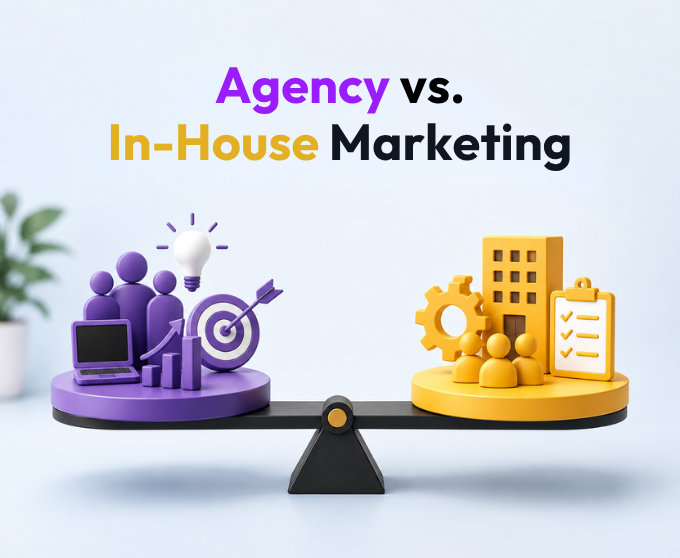
The marketing agency vs in-house team decision is less about headcount and more about continuity and specialisation. A small in-house team can run one or two core channels well. The moment you need paid media, SEO, content marketing, social media marketing, and brand strategy moving together, and staying consistent through leadership changes, a marketing agency usually holds up better than an internal team built around one or two generalists.
The Leadership Continuity Problem Nobody Plans For
Marketing strategy is only as stable as the person who owns it, and that person moves faster than most brands admit. The average tenure for a chief marketing officer at S&P 500 companies is just 4.1 years, well below the 5.0-year average across all C-suite roles at those companies. Every time that seat changes, priorities reset, agencies get re-briefed, and campaigns years in the making lose their internal champion. An in-house marketing team inherits this instability from the top down. A marketing agency, structured correctly, sits outside that churn and carries brand history and channel data across reorganisations instead of losing them with every departure.
The Skills Gap Hiding Inside Every In-House Team
CMI's 2026 Career Outlook found 76 percent of marketers now do the work of more than one job, the ghost workforce trend. This shows up beyond content too. Sixty-four percent of organisations admit they lack sufficient internal marketing technology or operations expertise to run the tools they already own, and only about a third of martech capabilities in a typical stack are ever actually used. A lean in-house team is rarely under-resourced because it hires badly. It is under-resourced because modern digital marketing spans more disciplines than a handful of generalists can master.
The Agency Objection, and Why It Is Usually Solvable
The honest critique of agencies is context: an external team is not in your daily standups by default. That gap closes fast with the right structure: a dedicated strategist who runs weekly syncs, documents brand voice, and stays with the account through leadership changes. The fully in-house team is already the minority model. Only 35 percent of B2B businesses handle all marketing internally, and roughly half outsource at least one content marketing function to specialists who are not stretched across five roles at once. That is not brands settling; it is recognising what a lean internal team cannot realistically cover alone.
The Model Most Brands Actually End Up Using
The recurring pattern: brands build a small in-house team to own brand judgment and day-to-day coordination, then lean on a marketing agency for specialist execution, paid media, SEO, content marketing, and design, that would otherwise require five separate hires. This works because a capable agency absorbs strategy continuity and production once it understands the brand, without the single-point-of-failure risk a lean internal team carries alone.
The Hidden Variable: AI Answer Engines Are Changing the Math
Content increasingly needs to answer questions directly enough for AI search tools and answer engines to cite it, not just rank on a results page. That requires structured, fact-dense writing and consistent publishing across content marketing and social media marketing simultaneously, exactly the workload a lean internal team struggles to sustain alongside paid media and reporting. In 2025, 77.6 percent of marketers named getting content to rank as their top frustration, and 70.6 percent struggled to meet search intent, per Siege Media research compiled by BizIQ, 2026. Strategic thinking time is the bottleneck, and a specialist team tracking algorithm shifts daily has more of it than a stretched-thin internal team.
A Simple Decision Framework
- One or two core channels and stable leadership: a lean in-house team can work well.
- Multiple channels running together, paid media, SEO, content marketing, and social media marketing: a digital marketing agency or hybrid model, since specialist depth in five disciplines rarely lives inside one small team.
- Frequent leadership change or no permanent CMO: agency, since it protects continuity an internal team structurally cannot.
- Brand voice as your moat, founder-led or niche DTC: a dedicated agency strategist can protect it without depending on one internal hire staying put.
Conclusion
There is no universally correct answer, but the data leans one way: a lean internal team concentrates skill and leadership risk in a few people, while the right marketing agency spreads specialisation and continuity across a team built to outlast any departure. The honest starting point: audit what your brand needs covered every month, and how much of that depends on one person staying put, then match the model to that instead of a trend.
If you are weighing that decision right now, this is the audit Creative Nerds runs for brands every week to determine what their marketing function needs. Call or WhatsApp us at +91 91670 08137, and let us map it out.