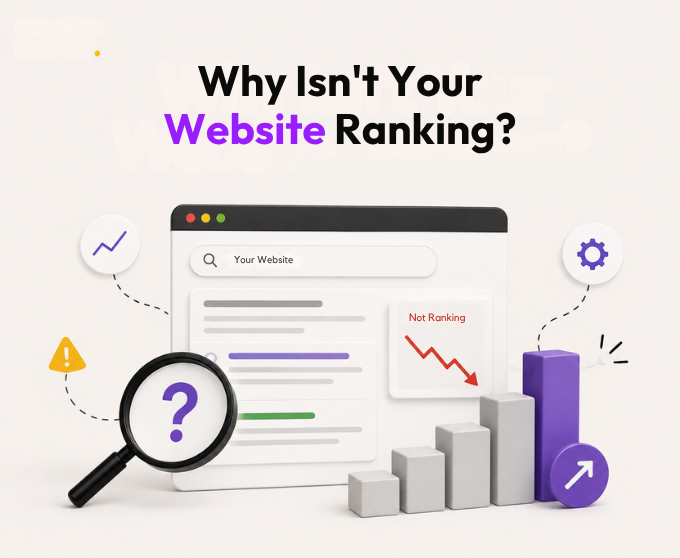
The Google you optimized for stopped existing a while ago. Most brands asking "why is my website not ranking on Google" are still fighting a 2019 battle with 2019 weapons. The real issues are usually zero-click search, weak trust signals, hidden technical debt, and SEO working in total isolation from social media marketing. Fix those four, and rankings tend to follow.
That is not a hot take. That is the data. And it is not an argument against SEO services. It is an argument for the right kind.
The Uncomfortable Truth Nobody Tells You About SEO Right Now
You did the audit. You wrote the blog posts. You built a few backlinks. Months passed. Traffic barely moved. You assumed SEO had failed.
It did not fail. It just is not measuring what you think anymore.
Search results increasingly end without anyone clicking anything, a pattern researchers call zero-click search, and 2026 studies suggest well over half of all queries now resolve without a single click. When an AI Overview appears, clicks to actual sites can drop by roughly a third or more, even when searchers feel satisfied. That is not a ranking problem. That is a structural shift in how search itself works, and no amount of keyword stuffing fixes a structural shift.
Reason 1: Chasing an "AEO Trick" That Google Says Does Not Exist
A lot of SEO services are currently selling Answer Engine Optimization, or AEO, as a separate checklist with special formatting to unlock AI Overviews. Google's own documentation says the opposite. There are no additional requirements or special optimizations needed to appear in AI Overviews or AI Mode, no new file to create, no unique schema to add, because AI Overviews pull from the same index as regular search results.
That is inconvenient news for anyone selling a shortcut, and useful news for everyone else. If your content is not strong enough to rank normally, it was never going to be strong enough for an AI Overview either. The real work is the same as it always was: content that actually answers one question clearly, well enough that a human and an algorithm can both use it immediately.
Reason 2: You Pass the Keyword Test but Fail the Trust Test
Here's a fact most brands miss. Google evaluates content quality across the entire site, not page by page. A few thin pages can drag down the good ones. Google's own quality rater guidelines are built around Experience, Expertise, Authoritativeness and Trustworthiness, known as E-E-A-T, and that same framework applies to AI-generated content just as much as human-written pages.
Most websites we audit have close to zero real experience signals. No author bios, no original data, no case studies, no proof anyone actually did the thing they are writing about. You cannot design your way around trust. You earn it, one honest page at a time.
Reason 3: The Technical Debt You Cannot See
Somewhere on your site is a redirect chain nobody remembers, a bloated script slowing mobile load, or two pages competing for the same keyword. None of this shows up when you skim the homepage. It shows up in crawl reports, and in the audits we run, sites are consistently being crawled less thoroughly than their owners assume.
Core Web Vitals, indexation health, duplicate content and internal linking are unglamorous. Nobody writes an Instagram caption about canonical tags. But this is the plumbing. You can have the best content in your niche and still lose, quietly, to a competitor whose site simply loads faster and gets crawled more efficiently.
Reason 4: SEO and Social Media Marketing Are Not Separate Departments Anymore
This is the one brands consistently get wrong. They treat SEO and social media marketing like two teams that never speak. In 2026, that is an expensive habit.
Social platforms are not a direct Google ranking factor, and Google has said so plainly. But social content drives branded search and reinforces the trust signals search engines actively look for. When people see your brand repeatedly on social, engage with it, then later type your name into Google, that behavior tells search engines your brand is real and worth surfacing. AI search tools increasingly pull from social conversation too. One sharp LinkedIn post or Reel can shape whether an AI engine recognizes your brand as a source worth citing.
If your SEO team and social team have never once met, that is likely why you are not ranking.
Reason 5: You Are Judging a Marathon at Mile Two
Google's own public guidance says most SEO work needs four months to a year before results show up meaningfully, longer for competitive industries or newer domains. That same guidance draws a clear line between fix types: a small technical tweak like a title tag gets recrawled and reprocessed quickly, while broader content and quality changes across a site can take Google weeks or months to fully recrawl and reflect in rankings. If your idea of "months of SEO" is really six weeks and a new meta description, you have not really given the work time to work yet. Real results take real patience, not a rushed audit.
Conclusion
Stop treating SEO as a one-time checklist and start treating it as an ongoing system where content, technical health, trust signals, and social media marketing all pull in the same direction. That is exactly the kind of cross-functional, slightly obsessive thinking Creative Nerds builds its SEO services around. We do not just chase rankings. We decode why they are not moving, then fix the actual root cause.
If your website has been "doing SEO" for months with nothing to show for it, maybe it is time to stop guessing and start debugging.
Ready to find out why your rankings are stuck? Call the Creative Nerds at +91 91670 08137 or get in touch here.